The guesthouse in Sighnaghi had one rule, posted on a handwritten card above the kitchen table. It said: If you cook, you cook for everyone. That was it. No checkout time. No noise policy. No list of prohibited activities. Just that one rule, in Georgian and English, in someone's careful handwriting.
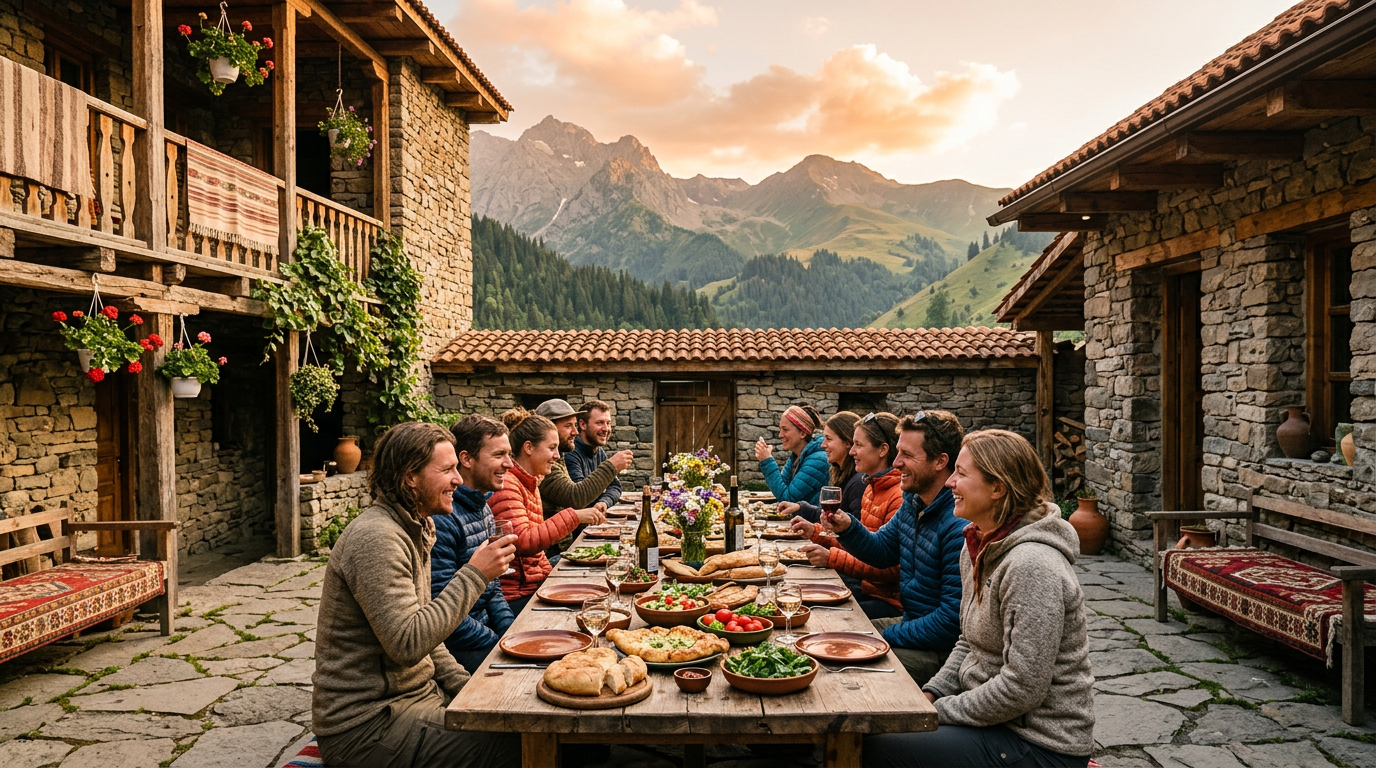
I arrived on a Tuesday in late October. There were four other guests — a Dutch couple who'd been there a week, a solo traveler from Japan who was working on something she didn't explain, and a Georgian man from Tbilisi who was visiting his grandmother in the next village and had decided to stay somewhere that wasn't her house. We were strangers. By Thursday we were eating together every night.
The rule did that. Not the guesthouse owner, who was warm but not intrusive. Not the location, which was beautiful but not uniquely so. The rule. Because the rule meant that if you wanted to cook — and the kitchen was good, and the market was two minutes away — you had to make enough for everyone. And if you were going to make enough for everyone, you had to talk to everyone. And if you talked to everyone, you stopped being strangers.
The Architecture of Encounter
I've been thinking about this in terms of what the art and texture from the road writers call the architecture of encounter — the way physical and social structures either enable or prevent connection. Most guesthouses are designed for privacy. Individual rooms, individual bathrooms, a common area that nobody uses because there's no reason to be there. The Sighnaghi guesthouse was designed for encounter. The kitchen was the center. The rule made the kitchen a place where something happened.
The Dutch couple made stamppot on Wednesday. They'd found potatoes and kale at the market and they made enough for eight people, which was four more than were staying there. The owner ate with us. A neighbor came by and stayed. The Japanese traveler, who had been quiet for two days, talked for three hours about her project, which turned out to be a book about traditional wine-making in the Kakheti region.
The morning practice and grounding quality of the place was real — there was something about the rhythm of the days there, the shared meals, the lack of agenda, that felt like a kind of reset. Not a retreat, not a wellness thing, just a place where the structure of the day was organized around eating together rather than around individual schedules.
What the Rule Actually Did
The rule worked because it was specific and it was reciprocal. It didn't say "be friendly" or "respect other guests." It said: if you do this particular thing, you do it for everyone. The specificity made it actionable. The reciprocity made it fair. Nobody felt imposed upon because everyone was subject to the same condition.
I've stayed in a lot of guesthouses. I've stayed in places with long lists of rules and places with no rules at all. The calitoy culture and travel thinking about community design applies here: the best communities have a small number of rules that are specific, reciprocal, and create the conditions for the thing you actually want to happen.
One rule. If you cook, you cook for everyone. I've been thinking about what the equivalent would be in other contexts — in a studio, in an office, in a neighborhood. What's the one rule that creates the conditions for the thing you want?
More from the road at Have a Field Trip.