The Village in the Rock
Monsanto, Portugal — not the American company, the village built into a granite boulder — has a bread oven from 1887 that still works. The village uses it on Saturdays. You can smell it from the road that winds up the hill, past the houses that are half-house and half-rock, where the granite has been incorporated into the walls so completely that you can't tell where the mountain ends and the building begins.
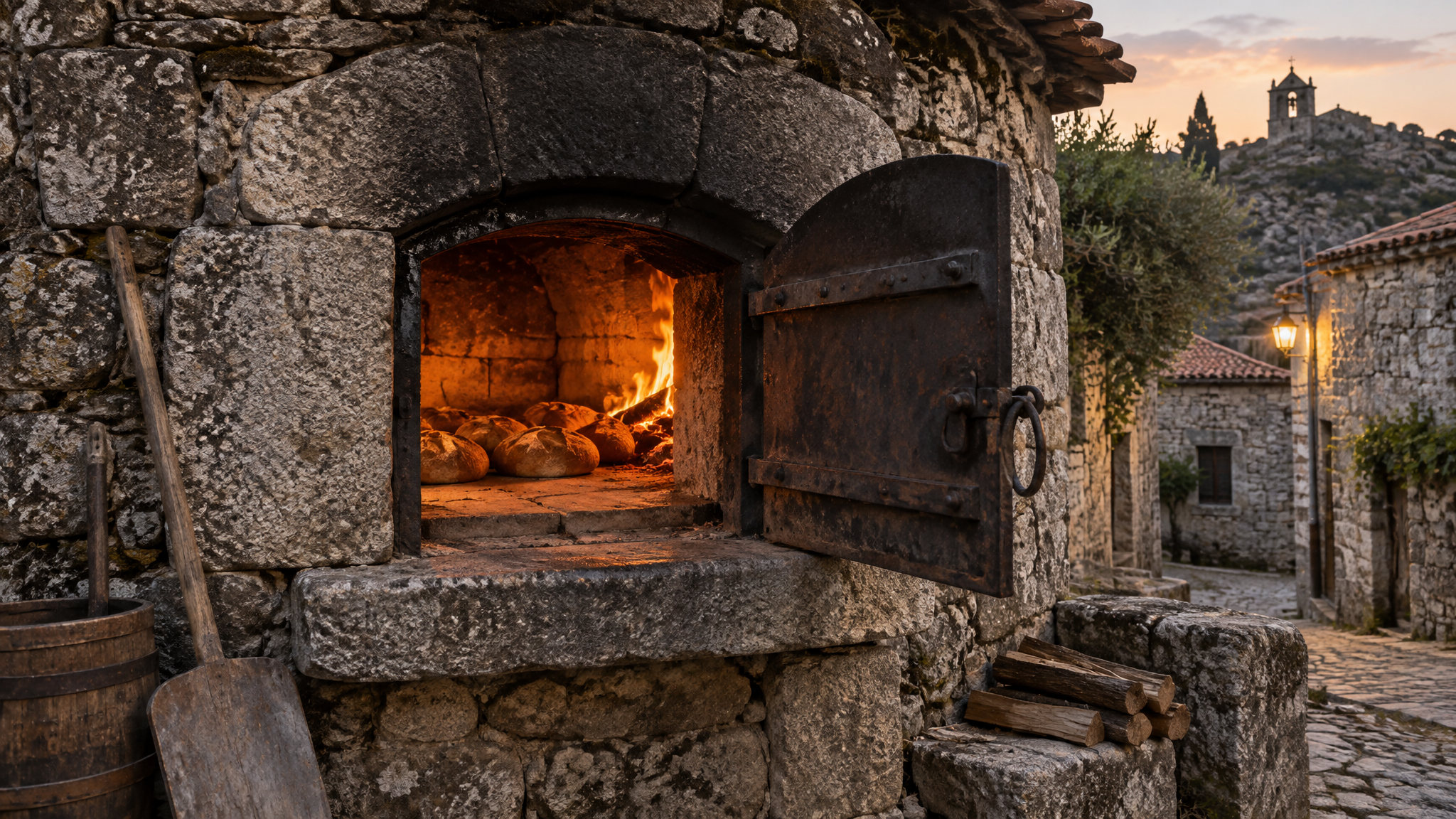
I arrived on a Thursday, which was the wrong day for bread. But the oven was still there, and the woman who lives next to it was willing to talk about it, which was enough.
What the Oven Is
It's a communal bread oven — a forno comunitário — built from the same granite as everything else in Monsanto. The interior is domed, about two meters across. The floor is worn smooth from a hundred and thirty-nine years of bread. The door is iron, original, with a latch that requires a specific motion to open: lift, then push, then lift again.
The woman who lives next to it — her name is Conceição, she's seventy-three, she's lived in Monsanto her entire life — told me that the oven was built by her great-grandfather's generation. Not her great-grandfather specifically, but that generation. The village built it together. That's how things were done.
She said this without nostalgia. It was a fact, like the granite was a fact. The oven exists. The village uses it. That's the situation.
What Outlasts What
Monsanto has outlasted a lot of things. The Roman occupation left traces — there's a castle on the highest point of the boulder, built on Roman foundations, rebuilt by the Moors, rebuilt again by the Portuguese. The village has been here, in some form, for two thousand years. The bread oven is a recent addition by comparison.
What strikes me about places like this — and I've been to a few, the kind of places that have been continuously inhabited for longer than most countries have existed — is the specific relationship they have with time. Not reverence for the past, exactly. More like a practical acknowledgment that things that work tend to persist, and things that don't tend to disappear, and the oven works so the oven is still here.
The texture and craft of the oven is worth noting. The granite has been worn by hands and heat into something that looks almost polished. The iron door has a patina that no amount of deliberate aging could replicate. These are surfaces that have been used, and the use is visible in them.
The Saturday Bread
I came back on Saturday. The oven was lit by seven in the morning. By nine, the smell had reached the lower part of the village. By eleven, there were six or seven people gathered around it, each with their own loaves, each with their own timing.
The bread is a dense, round loaf — pão de Monsanto — made from wheat flour and water and salt and a starter that Conceição says has been going for forty years. She feeds it every week. It lives in a ceramic pot in her kitchen. When I asked if she'd ever let it die, she looked at me like I'd asked something strange. Of course not. Why would she let it die?
The grounding practices that persist across generations tend to be the ones that are also practical. The bread oven is a grounding practice. It's also just a way to make bread. The two things aren't in conflict.
Getting There
Monsanto is in the Beira Baixa region of Portugal, about three hours from Lisbon by car. There's no train. The road up to the village is narrow and the parking is limited — leave the car at the bottom and walk. The walk takes about twenty minutes and is worth it for the view alone.
Stay at least one night. The village is different in the evening, when the day-trippers have left and the light goes golden on the granite. The culture of a place reveals itself after the tourists leave. Monsanto is no exception. More off-the-beaten-path travel at Have a Field Trip.